Science & Space
Neurons
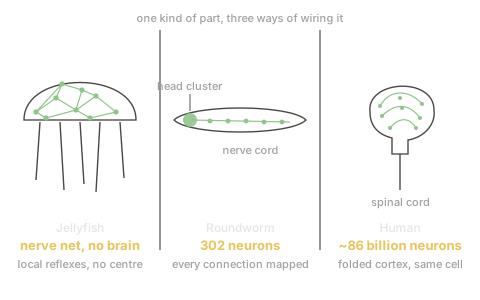
A jellyfish has no brain. A roundworm has 302 neurons. You have about 86 billion. Yet the cell doing the work in all three is, to a close approximation, the same cell. It rests at the same voltage, fires the same kind of spike, and talks to its neighbours with the same chemicals. What changed over 600 million years is not the part. It is the wiring.
What a neuron does
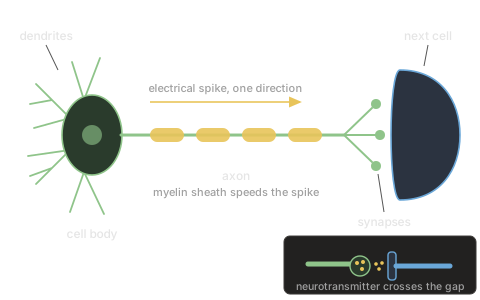
A neuron is a cell shaped for communication. Branches called dendrites collect input. A long fibre called the axon carries output. Where the axon meets the next cell there is a tiny gap, the synapse, and the message crosses it as a chemical.
The cell keeps its inside slightly negative compared to the outside, around −70 millivolts, by pumping sodium out and potassium in. That stored imbalance is the battery. When enough input arrives, voltage-gated sodium channels snap open, sodium floods in, and the voltage flips positive for about a millisecond. Potassium channels then open and reset it. That brief flip is an action potential, or a spike.
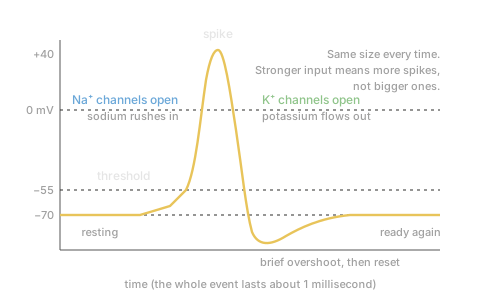
Three rules fall out of this. A spike is all-or-nothing: it either happens at full size or not at all. Intensity is carried by rate: more spikes per second means a stronger signal. And the spike regenerates as it travels, so it arrives at the far end of a long axon just as sharp as it left.
At the synapse the spike triggers release of a neurotransmitter, such as glutamate, GABA, dopamine, or serotonin. Some transmitters push the next cell toward firing. Some hold it back. That excite-or-inhibit logic is what lets circuits say "do this, not that."
Hodgkin and Huxley worked all of this out in 1952 using the giant axon of a squid, because it was fat enough to put an electrode inside. Their equations, fitted to a squid, describe your neurons too. That was an early hint of how universal the mechanism is.
The same part, everywhere
Max Bennett opens A Brief History of Intelligence with this point, and it is the hinge the whole book turns on. Every animal with neurons descends from one ancestor in which the neuron first appeared. Bennett puts it bluntly:
“It seems that in this ancient grandmother of animals, neurons attained their modern form; from this point on, evolution rewired neurons but made no meaningful adjustments to the basic unit itself.”
Max Bennett, A Brief History of Intelligence
He lists the features that are shared across the animal kingdom: all-or-nothing spikes, rate coding, adaptation (the threshold shifts so the cell stays sensitive to faint input without overreacting to strong input), and chemical synapses with both excitatory and inhibitory transmitters. In his words, these “are universal across all animals, even in animals that have no brain, such as coral polyps and jellyfish.” The fundamental building blocks of brains, he writes, “have been essentially the same for over six hundred million years.”
The chemistry travels with the cell. The roundworm C. elegans, with its 302 neurons, uses dopamine and serotonin, the same molecules behind human craving and contentment. In Bennett's telling, the worm releases dopamine when food is detected nearby and serotonin when food is detected inside it. He summarises dopamine as the “something-good-is-nearby chemical” and serotonin as the “something-good-is-actually-happening chemical.” That template, he argues, is still visible in us.
| Animal | Nervous system | Neurons |
|---|---|---|
| Jellyfish | Nerve net, no brain | thousands |
| Roundworm (C. elegans) | Head cluster and nerve cord, fully mapped | 302 |
| Fruit fly | Brain, fully mapped (see The Fly Brain) | ~140,000 |
| Mouse | Brain with a smooth cortex | ~70 million |
| Human | Brain with a folded cortex | ~86 billion |
Read down that table and the neuron does not change. The count does, and the arrangement does. A worm neuron would not look out of place in a human brain.
From nerve net to brain
The first animals with neurons had no brain. Like today's jellyfish and coral, they had a nerve net: a distributed web of independent reflex circuits, each handling its own patch of body. Touch here, contract there. There was no centre where signals were compared.
Bennett's first breakthrough is steering. Once animals evolved a bilateral body, with a front and a back, moving through the world reduced to a simpler problem: go forward, or turn. A cluster of neurons at the front end could weigh competing smells and pick one direction. As he puts it, “all you need is a brain that steers a bilateral body toward increasing food smells and away from decreasing food smells.” That cluster was the first brain. It did not need new neurons. It needed the old ones wired into a decision.
Everything after that, in Bennett's account, is more rewiring: learning by trial and error in early vertebrates, simulating the world in mammals, modelling other minds in primates, and language in humans. Each breakthrough is a new architecture built from the same cell.
Where the parts came from
The neuron did not appear from nothing. Most of its components are older than animals.
- Ion channels. The voltage-gated channels that make a spike have ancestors in single-celled organisms. Choanoflagellates, our closest single-celled relatives, already carry a version. Sodium-selective channels appear to have evolved separately in cnidarians (jellyfish, anemones) and in our own lineage, from a shared, less selective ancestor.
- Synapse proteins. Sponges have no neurons, yet carry well over a hundred genes of the human synapse toolkit. The pieces were lying around before any cell used them to talk.
- Proto-neurons. Placozoans, flat animals a millimetre across with no neurons at all, coordinate behaviour with peptide-secreting cells that express much of the neuron's sending machinery. A 2023 study in Cell describes them as a stepping stone: the output half of a neuron without the input half.
One honest wrinkle: comb jellies (ctenophores) have neurons, but odd ones. In 2023, electron microscopy showed that part of their nerve net is a syncytium, cells fused into one continuous membrane rather than separated by synapses. Whether neurons evolved once and comb jellies drifted, or evolved twice, is still argued. Either way, the cnidarian-to-human line, which covers every animal with a brain, shares one design.
Why it matters
- Simple animals are real evidence. If the cell is the same, a worm or fly is a legitimate place to study how circuits produce behaviour. That is why a fully mapped fly brain is such a big deal.
- Intelligence is an architecture question. Nothing special was added to the neuron on the way to humans. The differences are in how many there are and how they connect.
- Artificial networks borrowed the abstraction. A unit that sums inputs, passes a threshold, and sends one output is the neuron with the biology stripped away. See LLM Training.
Further reading: Max Bennett's conversation on Brain Inspired covers the opening of the book; the primary papers are Zakon (2012) on sodium channels, Gur Barzilai et al. (2012) on convergent sodium selectivity, Wong et al. (2019) on sponge synapse genes, commentary on Najle et al. (2023) on placozoan proto-neurons, and Burkhardt et al. (2023) on the comb jelly nerve net.