Science & Space
Photosynthesis
Every green leaf is running a quiet factory. Plants, algae, and some bacteria take carbon dioxide from the air and, with sunlight, turn it into sugar. That one trick feeds nearly everything else that lives.
A simple explanation
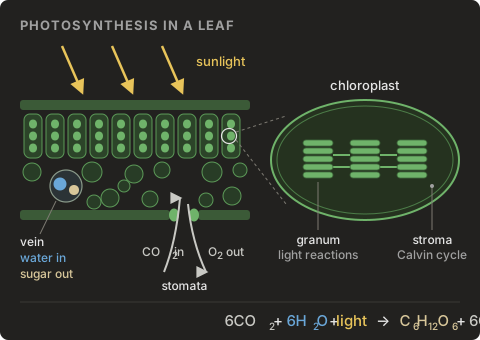
A plant drinks water through its roots and takes in carbon dioxide through tiny pores on its leaves called stomata. Inside the leaf, a green pigment called chlorophyll sits in little compartments called chloroplasts and catches sunlight.
Light gives the plant the energy to split water and stitch carbon from the air into sugar. Oxygen is leftover from the water and floats away. That leftover is the air we breathe.
The whole story in one line:
6CO2 + 6H2O + light energy → C6H12O6 + 6O2
Carbon dioxide and water become glucose and oxygen. Sunlight pays the bill.
There are two stages. First, light hits the leaf and the plant stores that energy in two small molecules, ATP and NADPH. Then, in a cycle that does not need light directly, those molecules help lock carbon dioxide into sugar.
How it works
The same process, with the names of the parts. The light-dependent reactions happen on the thylakoid membranes, stacked like coins inside the chloroplast. The Calvin cycle happens in the stroma, the fluid around those stacks.
Hover, tap, or tab to any part of the diagram to see what it does. Light reactions run along the thylakoid membrane at the top; the Calvin cycle runs in the stroma below.
Light-dependent reactions
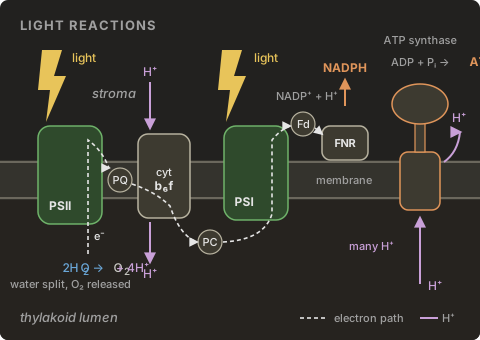
Sunlight hits photosystem II. Chlorophyll there loses an electron. To replace it, an enzyme splits water: electrons go into the photosystem, protons stay inside the thylakoid, and oxygen is released as a byproduct.
The excited electron travels down an electron transport chain. As it moves, protons are pumped into the thylakoid space, building a gradient. The electron then arrives at photosystem I, gets another boost from light, and is passed to NADP+, making NADPH.
ATP synthase lets the piled-up protons flow back out. That flow turns the enzyme and makes ATP from ADP and phosphate.
So the light reactions produce oxygen, ATP, and NADPH. The ATP and NADPH are the currency the next stage spends.
The Calvin cycle
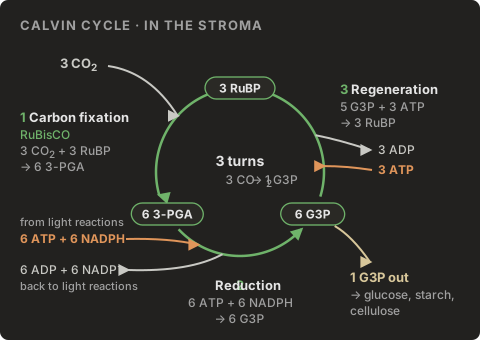
The Calvin cycle uses that ATP and NADPH to fix carbon dioxide into sugar. It has three phases.
- Carbon fixation. The enzyme RuBisCO attaches CO2 to a five-carbon sugar called RuBP (ribulose-1,5-bisphosphate). The product splits into two molecules of 3-phosphoglycerate (3-PGA).
- Reduction. ATP phosphorylates 3-PGA, then NADPH donates electrons. The result is glyceraldehyde-3-phosphate, or G3P, a three-carbon sugar.
- RuBP regeneration. Most of the G3P is rearranged, with more ATP, back into RuBP so the cycle can run again.
Some G3P leaves the cycle. Two G3P molecules can be joined to make glucose (C6H12O6). Plants also build starch, cellulose, and the rest of their bodies from this carbon.
6CO2 + 6H2O + light energy → C6H12O6 + 6O2
Origins
Some of the earliest life on Earth figured this out. Cyanobacteria learned to use sunlight and carbon dioxide to make sugar. The oxygen they released was a waste product, and over time it changed the planet.
Around 2.4 billion years ago, that oxygen built up in the atmosphere. The event is called the Great Oxidation Event. It remade the sky and the oceans, and it opened the door to life that breathes oxygen.
The chloroplasts in plant cells are descendants of those bacteria. Long ago, a larger cell swallowed a cyanobacterium and kept it. That partnership became the green engine inside every leaf.
-
1About 3.5 to 2.7 billion years ago
Cyanobacteria
Ancestors of today's cyanobacteria start splitting water for its electrons, and oxygen becomes a waste product. Exactly when this began is still debated.
-
2About 2.4 billion years ago
Great Oxidation Event
Oxygen finally builds up faster than rocks and volcanic gases can absorb it. Dissolved iron rusts out of the seas, leaving striped rocks called banded iron formations.
-
3Roughly 1.5 billion years ago
Endosymbiosis
A larger cell swallows a cyanobacterium and keeps it instead of digesting it. Over many generations it becomes the chloroplast, which still has its own small DNA and a double membrane. Estimates of the date range widely.
-
4About 470 million years ago
Plants move onto land
Descendants of green algae spread across the continents. Forests later pull huge amounts of carbon dioxide from the air, and some of that carbon is buried as coal.
Why it matters
- Food. It is the base of nearly every food chain. The sugar plants make is the starting energy for almost all other life.
- Oxygen. It is the source of the oxygen we breathe.
- Carbon. It pulls carbon dioxide out of the atmosphere and locks carbon into living things.
- Fossil fuels. Coal, oil, and gas are ancient stored photosynthesis: sunlight captured by plants and buried for millions of years.