Science & Space
Carl Sagan
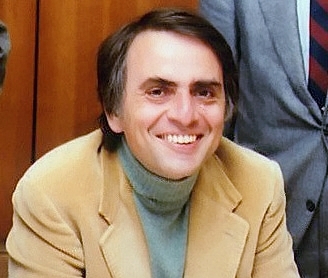
Carl Sagan (1934-1996) was an astronomer, planetary scientist, and one of the greatest science communicators ever. What I love most about him is exactly what made him special: his ability to explain complex ideas in plain language without losing the depth.
Quick background
- Born: November 9, 1934, Brooklyn, New York
- Died: December 20, 1996, Seattle, Washington
- Field: Astronomy, astrophysics, planetary science, astrobiology
- Academic home: Cornell University
- Public impact: Creator and host of Cosmos: A Personal Voyage
The Pale Blue Dot
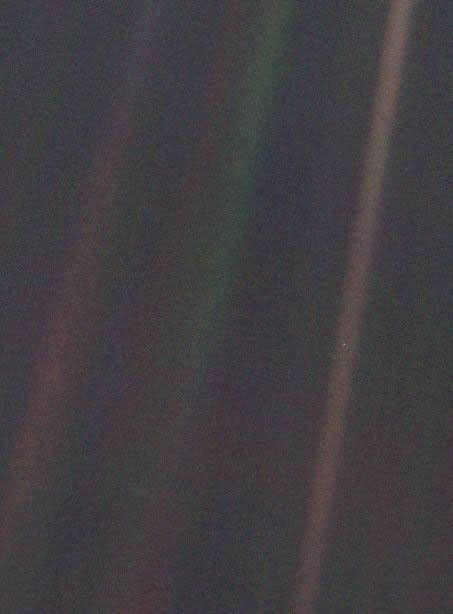
Earth, seen by Voyager 1 on February 14, 1990. Look for the tiny bright point near the right side, a little below halfway down, inside the pale band of light. The band comes from sunlight scattered inside the camera.
Sagan championed the idea of turning Voyager's camera back toward Earth. The image inspired his 1994 book, Pale Blue Dot, and his reflections on our shared home.
Original image: NASA/JPL-Caltech. View NASA's image and description. Sagan's role in the photograph.Biggest scientific contributions
1) Planetary atmospheres and climate
Sagan helped explain the runaway greenhouse effect on Venus and highlighted how atmospheric physics can radically shape a planet's surface conditions. His work connected planetary science to climate understanding in a way that still matters today.
2) Mars and seasonal change
He studied Mars in depth and contributed to early interpretations of Martian surface and atmospheric behavior, helping frame better scientific questions for later missions.
3) Search for extraterrestrial intelligence (SETI)
Sagan was central in making SETI a legitimate scientific program. He advanced serious discussion of biosignatures, technosignatures, and how humanity might detect life beyond Earth.
4) Planetary mission participation
He advised and contributed to multiple NASA-era planetary efforts, including work tied to the Mariner, Viking, and Voyager eras of exploration. On Cassini specifically, he was not a mission lead, but his broader advocacy for planetary science helped shape the public and scientific culture that made missions like Cassini so valued.
5) Science communication as a scientific force multiplier
Through TV, books, and lectures, he brought rigorous science to a global audience and inspired millions of people into astronomy, physics, and engineering.
Books (selected)
- Cosmos (1980)
- The Dragons of Eden (1977)
- Broca's Brain (1979)
- Pale Blue Dot (1994)
- The Demon-Haunted World (1995)
- Contact (1985, novel)
Cosmos is one of my favorite books too. It is incredible.
Favorite ideas and quotes
"We are made of star-stuff. We are a way for the cosmos to know itself."
That idea is one of the most powerful things Sagan ever expressed. It is a meta perspective that reminds us we are not separate from the universe. We are the universe observing itself.