Blog / Technology
My Tech Stack: How I Run Almost Everything Through Cursor
January 21, 2026

A look at the tools I use to learn, develop, and create.
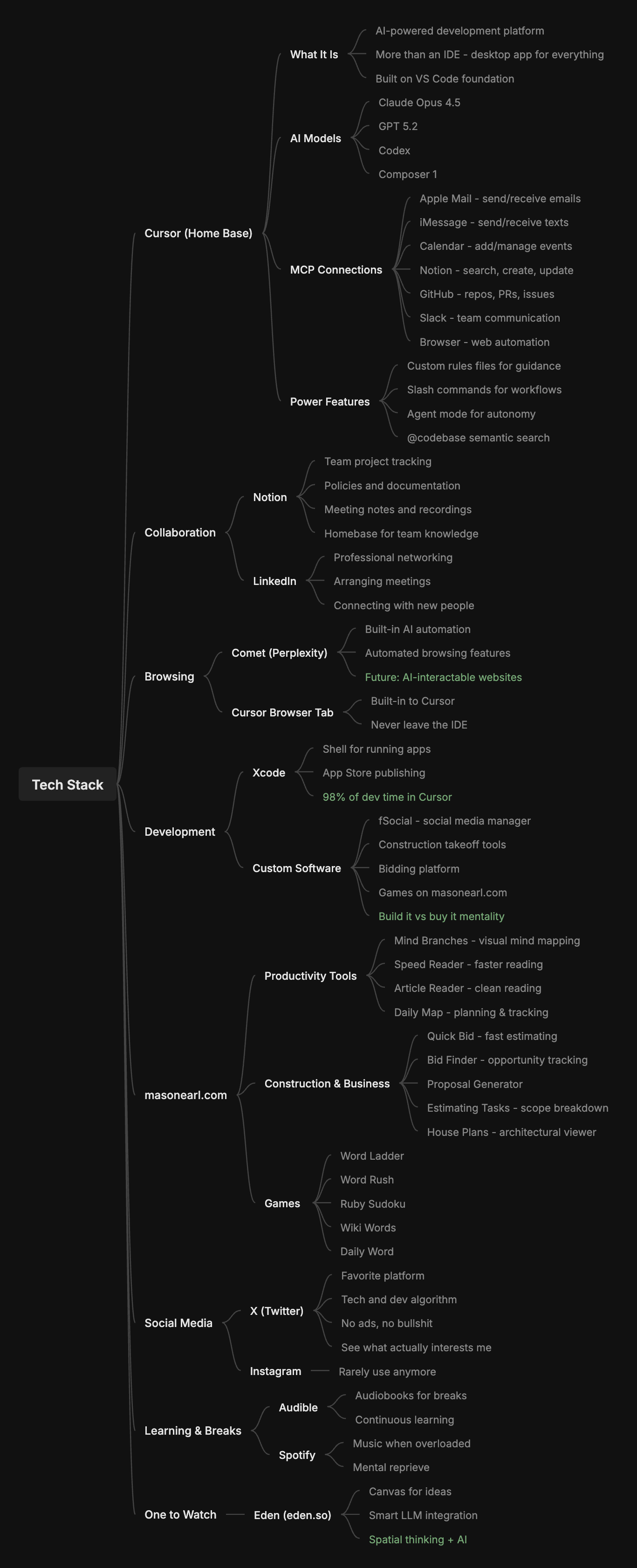
The Home Base: Cursor
Everything starts and ends in Cursor. Most people think of it as a code editor, but that drastically undersells what it actually is. Cursor is a desktop application that serves as a full development platform - and increasingly, it's become my command center for nearly everything I do on a computer.
Built on VS Code, Cursor integrates the latest AI models directly into the development experience. I'm talking Claude Opus 4.5, GPT 5.2, Codex, Composer 1 - the bleeding edge of what's possible with AI. These aren't just chatbots you ask questions to. They're models that can read your files, understand your databases, make edits, run commands, and iterate until the job is done.
But here's the thing most people miss: these models are only as useful as the instructions you give them.
Most people use AI in a minimalist, ignorant way. They open ChatGPT, ask a vague question, get a vague answer, and walk away underwhelmed. That's like buying a Ferrari and only using it to drive to the mailbox. The power is there if you know how to unlock it.
The Secret: Rules and Custom Instructions
Cursor lets you create .cursorrules files and custom command definitions that guide the AI on exactly how to behave. I've spent time building these out so the AI knows:
- How I like my code formatted
- What conventions my projects follow
- When to use certain tools vs others
- How to format blog posts for my website
- How to draft emails without sounding like a robot
This is the difference between a generic AI assistant and a genuinely useful one. Specific prompting, custom rules, and clear instructions turn these models from party tricks into actual productivity multipliers.
MCPs: The Real Game Changer
MCP stands for Model Context Protocol. Think of it like USB for AI - a standard way to plug different capabilities into your AI assistant.
Through MCPs, my Cursor instance is connected to:
- Apple Mail - I can send and receive emails without leaving the editor
- iMessage - Same for texts
- Calendar - Add events with natural language
- Notion - Search, create, and update pages in my team's workspace
- GitHub - Full repo management, PRs, issues
- Slack - Team communication
- Browser - Automated web browsing and testing
This means I can sit in one application and run most of my digital life. Need to send a follow-up email? Don't open Mail - just tell Cursor. Want to check my calendar and add a meeting? Done without switching windows. Building a feature and want to test it in a browser? There's a browser tab built right in.
My favorite thing about Cursor is that I almost never have to leave it.
Collaboration: Notion
For team collaboration, Notion is the platform. It's where we track projects, store policies, take meeting notes, and create a home base for organizational knowledge.
Cursor connects to Notion through MCP, so I can search and update pages without context switching. But Notion's real value is as the collaboration layer - it's great for the things that need to be shared, discussed, and referenced by the team.
Browsing: Comet and the Future
When I'm not using Cursor's built-in browser, my go-to is Comet from Perplexity. It has some really compelling AI automation features baked in, and I genuinely believe automated browsing is where the web is heading.
The websites and tools that build interfaces AI can interact with directly will separate themselves from the competition. Most people haven't figured out how useful this can be yet. When they do, the companies that built for it will win.
Development: Xcode as a Shell
I build iOS apps, which means I technically need Xcode. But honestly, Xcode has become more of a shell for me - a place to run simulators and push to the App Store. 98% of my actual development time happens in Cursor.
The AI-assisted workflow is just so much faster. I can describe what I want, iterate quickly, and build features in a fraction of the time it would take otherwise.
Custom Software: Build It vs Buy It
Here's something that's changed my thinking: a lot of the custom software I've built is now part of my tech stack.
Why would I pay for a social media manager when I can build fSocial in a couple of nights? It's live in the App Store. Same with the construction takeoff tools I've built, the bidding platform on my website, and the games that serve as free alternatives to the New York Times subscription.
This is the real power of knowing how to develop. You stop being a consumer of software and start being a creator of it. If I can't find a tool that does what I need through Cursor, I'll usually just build a simple version myself.
masonearl.com: My Personal Tool Suite
My website has become more than a portfolio - it's an actual part of my daily workflow. I've built a collection of tools into it that I use regularly:
Productivity Tools
- Mind Branches - A visual mind mapping tool for organizing ideas and planning (this is where the tech stack visualization lives)
- Speed Reader - For getting through articles and documents faster
- Article Reader - Clean reading experience for web content
- Daily Map - Planning and tracking daily activities
Construction & Business
- Quick Bid - Fast estimating for construction projects
- Bid Finder - Finding and tracking bid opportunities
- Proposal Generator - Creating professional proposals
- Estimating Tasks - Breaking down project scope
- House Plans - Viewing and annotating architectural drawings
Games (NYT alternatives)
- Word Ladder - Word puzzle game
- Word Rush - Speed-based word game
Everything is free to use. The philosophy is simple: if I need a tool and it doesn't exist the way I want it, I build it and put it on the site. Over time, this compounds into a pretty useful collection.
Social Media: X Wins
My favorite social media is X. The algorithm shows me technology and development content - the stuff I'm actually interested in. No ads, no bullshit, just relevant content from people building interesting things.
Instagram has become a joke. Most of my professional networking happens on LinkedIn, where I connect with new people and set up meetings.
The Breaks: Audible and Spotify
When I need a break from information overload, I turn to Audible. Audiobooks are my reset button - a way to keep learning but give my eyes and hands a rest.
When even that is too much, Spotify provides the mental reprieve. Music without information, just sound.
One to Watch: Eden
There's a really interesting piece of software I've been eyeing lately called Eden. It's essentially a canvas for ideas that has integrated LLMs in a genuinely smart way. The approach feels different from most AI tools - it's designed around spatial thinking and connecting concepts visually, with AI woven into the fabric of how you work rather than bolted on as an afterthought.
Worth checking out if you're into tools that augment how you think rather than just automate tasks.
Why This Matters
We're living in a genuinely exciting time. The tools available to individual creators and developers are more powerful than what entire companies had access to a decade ago. But most people don't realize what's possible because they're using these tools in the most surface-level way.
Cursor isn't just an IDE. AI isn't just a chatbot. MCPs aren't just integrations. When you understand how to combine these things with intention and specificity, you unlock a way of working that feels almost unfair.
This is my first post on Substack as well - I plan to discuss the things that interest me: technology, development, building, and whatever else seems worth exploring. Hopefully some of this gives you a sense of what's possible and why I'm so excited about this moment we're in.
Truly exciting times.